Showing posts with label Obama. Show all posts

Friday, 17 June 2016

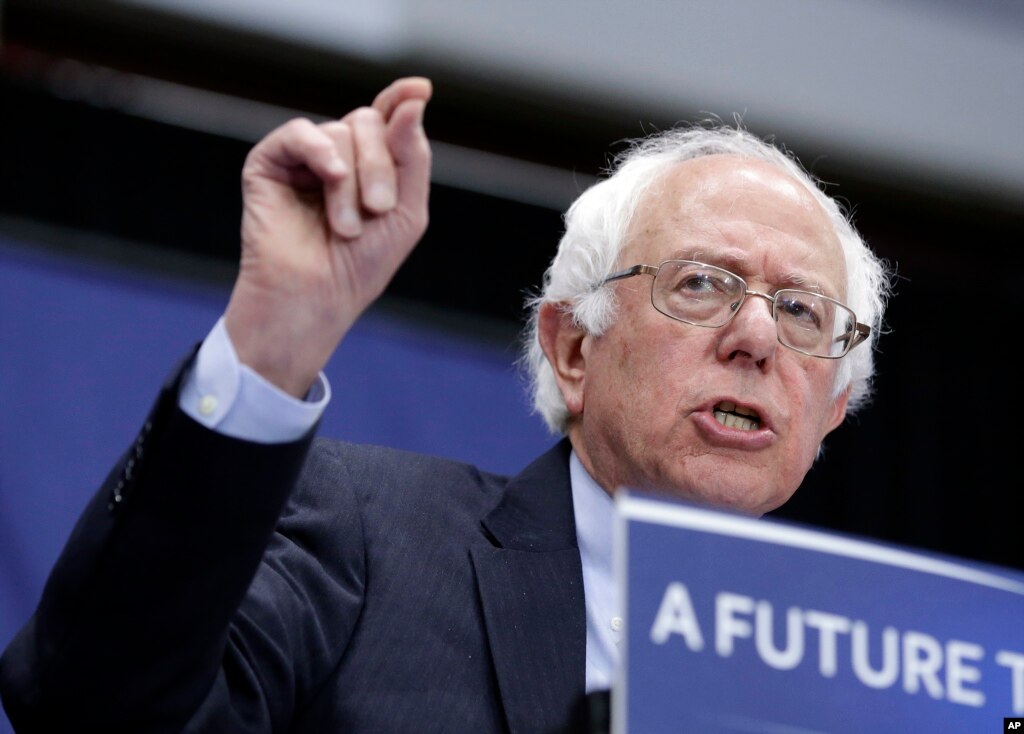
Sanders says he will work with Clinton to transform party.


Sanders says he will work with Clinton to transform party.

Democratic presidential candidate Bernie Sanders said Thursday in an address to his support that he will work with Hillary Clinton to transform the Democratic Party, adding that his "political revolution" must continue and ensure the defeat of the opposition Republican Donald Trump.

Sanders said in a capstone livestream address to his political followers that the major task they face is to "make certain" Trump is defeated. The Vermont senator said he plans to begin his role in that process "in a very short period of time."

"But defeating Donald Trump cannot be our only goal, Sanders report. We must continue our grassroots efforts to create the America that we know we can become," Sanders said, pointing to his 1,900 delegates at the upcoming Democratic National Convention in Philadelphia. Sanders spoke from his Vermont hometown a week after Clinton secured enough pledged delegates and superdelegates to become the presumptive nominee.

He did not concede the race, nor did he refer to Clinton as the likely nominee, instead offering a lengthy list of policy proposals he hopes to see approved by the party. The two rivals met Tuesday night at a Washington, D.C., hotel to discuss policy goals and future plans. Sanders said that while it is "no secret" that he and Clinton have "strong disagreements on some very important issues," it was "also true that our views are quite close on others."

He said he looked forward to additional talks between the two campaigns to ensure that his supporters' voices are heard and the convention adopts "the most progressive platform" in the party's history. Sanders said he anticipated working with Clinton "to transform the Democratic Party so that it becomes a party of working people and young people, and not just wealthy campaign contributors."

The speech — which could be Sanders' final address before the summer convention — was viewed by more than 200,000 people, according to the campaign. It sought to shape his legacy as a one-time "fringe" candidate who generated a massive following through sprawling rallies and threatened Clinton for the nomination.

Looking ahead to the convention, Sanders said the party must support a $15-an-hour federal minimum wage, pay equity for women, a ban on the sale and distribution of assault weapons and a defeat of the Trans-Pacific Partnership trade deal.

Sanders thanked his supporters for providing more than $200 million in donations, most in increments of $27, and rattled off what they had accomplished: 1.5 million people who attended his rallies and town meetings and more than 75 million phone calls from volunteers "urging their fellow citizens into action." He encouraged his followers to consider running for political office up and down the ballot as a way to prevent Republicans from controlling state and local government.

And he made clear that he intends to leave his imprint on the fall campaign and beyond. "We have begun the long and arduous process of transforming America, a fight that will continue tomorrow, next week, next year and into the future," he report.
Thursday, 16 June 2016

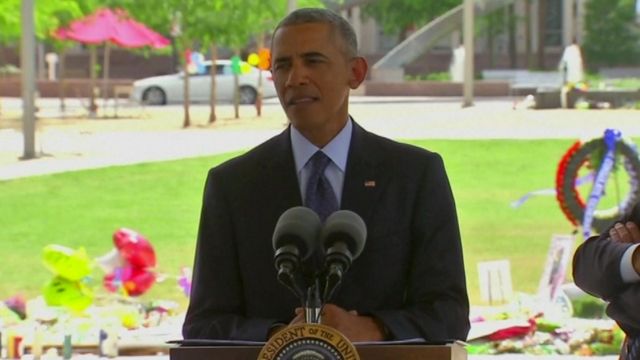
Orlando shooting: Obama meets survivors and families


Orlando shooting: Obama meets survivors and families

US President Barack Obama has privately visited survivors and the families of victims of the Pulse nightclub shooting in which 49 people died.

Speaking after laying flowers at a memorial for the victims in downtown Orlando, Mr Obama said that the gun control debate needed to change.

Obama to seek healing in Orlando even as politicians spar


Obama to seek healing in Orlando even as politicians spar

On a grim and delicate mission, President Barack Obama will offer solace and healing to a distraught Orlando, even as the political world turns the shooting into a fresh excuse to fight about terrorism and gun control.

In Orlando, Obama will confront an event whose causes seem to grow murkier by the day. Even as the families of 49 victims prepare to bury their loved ones, it's still unclear what confluence of factors led a 29-year-old Muslim born in New York to open fire in a gay nightclub where he may have been a frequent patron.

Typically, when the president visits a mourning community, the right message to deliver is relatively straightforward. After past incidents Obama has urged the nation to reject the attacker's ideology and do what it can to prevent such tragedies from happening again. This time, neither of those is clear. White House press secretary Josh Earnest said Obama would deal with the ambiguity by focusing on the victims.

"The president's visit to Orlando has nothing to do with the individual who perpetrated this terrible attack," Earnest said Wednesday. He said Obama would tell Orlando's residents "that they're not alone, even as they endure what surely have been several dark nights."

The White House released few details in advance about how Obama would spend his afternoon in Orlando, and aides said the trip had been hurriedly arranged in a fraction of the time usually required to plan a presidential trip. But Obama planned to meet with families of the victims, as well as with the doctors, paramedics and other first responders who came to their aid.

Obama also planned to speak publicly during his visit "to make clear that the country stands with the people of Orlando, stands with the LGBT community in Orlando, as they grieve for their loss," Earnest said. Vice President Joe Biden was to join Obama in Orlando.

The president's call for rejecting bigotry against gays and lesbians is complicated by the possibility that the gunman, Omar Mateen, may have been wrestling with his own sexuality. The FBI has been looking into reports that Mateen frequented the nightspot and reached out to men on gay dating apps.

Another challenge is to strike the appropriate tone at a time when the initial shock over the deadliest mass shooting in modern U.S. history has quickly given way to a vicious political brawl in Washington and on the campaign trail.

Since the shooting, presumptive Republican presidential nominee Donald Trump has expanded his call for temporarily barring foreign Muslims from entering the U.S., even though the attacker was an American, and insinuated that Obama sympathized with or even supported terrorists. In a rare bout of public anger, Obama denounced both Trump and the GOP leaders who are still supporting him. Many of those Republican leaders also denounced Trump's rhetoric.

In Congress, the attack has spurred yet another bitter fight over gun control, exposing deep frustration among supporters of stricter gun laws that no level of mass casualty seems to be enough to force gun control opponents to reconsider. Democratic Sen. Chris Murphy, whose state of Connecticut shouldered the killing of 20 children in Newtown in 2012, led a filibuster on Wednesday to try to force a vote, insisting he would stay on the Senate floor "until we get some signal, some sign that we can come together."

Murphy and other Democrats are pushing a change to let the government prohibit people suspected of being terrorists from buying guns. In an unexpected twist, Trump said he planned to meet with the National Rifle Association "about not allowing people on the terrorist watch list, or the no-fly list, to buy guns."

For Obama, the trip to Orlando is an unwelcome return to one of the most difficult roles a president must fulfill: comforting the nation at times when few words seem capable of providing much comfort. Obama has lamented the frequency with which he's had to perform that duty, calling his inability to enact stricter gun laws the biggest frustration of his presidency.

Wednesday, 15 June 2016

How America's gun problem was sloved by Alexander Hamilton — 228 years ago


How America's gun problem was sloved by Alexander Hamilton — 228 years ago

So many Americans. are killed by gun violence that even the most sensitive of us has grown numb to some degree. An Islamic extremist turns a gay nightclub into a grisly abattoir and we all know what comes next: nothing.

Regardless of your position on guns, two facts are beyond dispute: The National Rifle Association as a lobby is sufficiently powerful to stop confiscation laws dead in their tracks; and the astounding number of guns in America means even that if every gun manufacturer folded tomorrow, generations of Americans would still live in a nation awash in instruments of death, whether said death is directed at animals, intruders, or innocents.

These two facts were best confirmed by President Obama, who said during a townhall meeting earlier this month that "the notion that I, or Hillary, or Democrats, or whoever you want to choose, are hell-bent on taking away folks' guns is just not true, and I don't care how many times the NRA says it. I'm about to leave office.

There have been more guns sold since I've been president than just about any time in U.S. history. There are enough guns for every man, woman, and child in this country and at no point have I ever proposed confiscating guns from responsible gun owners.

This is true.

So what can be done? The answer is right there in the Second Amendment, unchanged since it first flowed from the quill of James Madison: "A well regulated Militia, being necessary to the security of a free State, the right of the people to keep and bear Arms, shall not be infringed."

Ask yourself: For what purpose did the Framers endow militias with such a special place in the Bill of Rights?

The Federalist Papers assert that local militias (as opposed to a "regular army, fully equal to the resources of the country") exist as a formidable check on federal power.

In Federalist 46, Madison writes of the local militia versus a national military:

It may well be doubted, whether a militia thus circumstanced could ever be conquered by such a proportion of regular troops. Those who are best acquainted with the last successful resistance of this country against the British arms, will be most inclined to deny the possibility of it.

Besides the advantage of being armed, which the Americans possess over the people of almost every other nation, the existence of subordinate governments, to which the people are attached, and by which the militia officers are appointed, forms a barrier against the enterprises of ambition, more insurmountable than any which a simple government of any form can admit of. [ Federalist 46]


Bearing arms is "the right of the people" who would make up a state militia, which protects us from national tyranny (even if Madison was overly generous in describing the efficacy of militiamen during the Revolutionary War).

In Federalist 29, published 228 years ago, in 1788, Alexander Hamilton concurs as to why militias are necessary:

If circumstances should at any time oblige the government to form an army of any magnitude that army can never be formidable to the liberties of the people while there is a large body of citizens, little, if at all, inferior to them in discipline and the use of arms, who stand ready to defend their own rights and those of their fellow-citizens. This appears to me the only substitute that can be devised for a standing army, and the best possible security against it, if it should exist. [Federalist 29]

People need firearms proficiency to defend against young soldiers of a standing army who might be, in Madison's words, "rendered subservient to the views of arbitrary power." Hamilton also elaborates on ideas that would later lead to the Second Amendment, and particularly the notion of a well-regulated militia. He is unambiguous in Federalist 29 on the point that people have a right to their weapons, and that they need not attend formal military training to be part of a militia, which would be "as futile as it would be injurious, if it were capable of being carried into execution.

A tolerable expertness in military movements is a business that requires time and practice. It is not a day, or even a week, that will suffice for the attainment of it.

By definition, then, a "well-regulated militia" would no longer seem to include the National Guard, which does require formal and sustained military training by the regular Army. At any rate, in its present incarnation, the Guard — as we saw in Iraq and Afghanistan — is a "state" force in name only. In practice, it is a part-time Army Reserve:

A national army that happens also to be used for natural disasters in home states. Hamilton writes further of the requirements of militia members: Little more can reasonably be aimed at, with respect to the people at large, than to have them properly armed and equipped; and in order to see that this be not neglected, it will be necessary to assemble them once or twice in the course of a year. [ Federalist 29]

So: If the whole point of the keeping and bearing of arms is to stock "well- regulated militias," why not mandate militia membership in order to own a gun? Before this suggestion is dismissed out of hand, I assert that the extremist so-called "militias" in Oregon, Ohio, and elsewhere — these people who live on compounds and confront federal agents — are not militiamen but rather insurrectionists. Insurrectionists should be excluded from this discussion.

They surrender any claim to the designation "militia" and any place in civil society. Proper militias would be comprised of sane men and women who own guns and wish to comply with state law. (And that is key: Militias belong entirely to the states, who regulate them accordingly.) Militias might be formed voluntarily based on like-mindedness and geography.

Never forgetting their purpose— the common defense— hunters in north Louisiana, for example, might form their own militia — which in practice would exist as a kind of society or association. State regulation of militias would seek to prevent the radicalization of any such group and thus suppress insurrectionists. Likewise, state laws and local governance from within a militia might find better luck in implementing piecemeal the gun reforms that confound federal legislatures.

Recall Hamilton's statement of fact that in order to be "well regulated," a militia should meet once or twice a year. This is key to a militia-based reform (as opposed to an arms- based one) and could easily be accomplished.

Precedent exists for large groups of people to assemble for one or two days a year to fulfill a civic obligation, and local governments are quite good at making such assemblies happen, as anyone who has ever been called to jury duty can attest. Because, as Hamilton writes, formal military training would entail "a real grievance to the people, and a serious public inconvenience and loss," how might these militias spend their two days of annual assembly? How about using those days as opportunities for gun safety training.

Why not bring the NRA to said meetings to conduct such training? Their political activities aside, the NRA is peerless with respect to teaching such classes. This also allows militia members to "feel each other out" and police one another, as all communities and associations are wont to do.

As militias would be geography based, members directly and through degrees of separation would run invariably across one another's Facebook profiles and the like. A monster like Dylann Roof, for example, might attract added attention with his pro-apartheid regalia, gun poses, burning American flags, and Confederate flag fixation.

His friends might not care and might well have similar beliefs but a group of sane gun owners familiar with the consequences of inaction might be more willing to keep an eye on the guy and flag him to local law enforcement. Likewise Omar Mateen not because of his name, religion, or skin color, but because he beat his wife and was reared by an unhinged video podcaster preaching pro-Taliban propaganda. Anyone who grew up in a small community knows: Fair or not, word of such things gets around.

And a militia, as it were, would be just such a community. This might not have directly prevented the massacres committed by Mateen or Roof or Adam Lanza. The simple disruption (or rather: restoration) of what it means to own a firearm, however, might well prevent future horrors. Gun owners would be given a vested interest in keeping firearms out of the wrong hands: pride in their militia.

Can there be a greater dishonor than an atrocity like the massacre in Orlando? It is a national stain, make no mistake. But if the perpetrator was the member of a local militia, the shame becomes local, and with that, a certain urgency to make sure it doesn't happen.

The result of compulsory militia membership for gun owners is actual reform whose design originates directly from the framers of the Constitution. This reform adds oversight, training, and state regulation while keeping the federal government out (militias existing specifically as a check on federal power); preserving the right to keep firearms; contributing perhaps to the security of the United States in some presently unimaginable future conflict at home that involves enemy divisions and open warfare; and has a better chance of seeing law than does confiscation or a repeal of the right to bear arms. Court precedents work against this argument.

But courts change, and new eyes will inevitably be set upon the Second Amendment. Still, I concede that the likelihood of this proposal ever surviving the gauntlet of our legislative process to be slim at best. I would consider a small chance of taking a first step in the right direction, however, to be preferable to the nothing that followed the unimaginable wholesale slaughter of first-graders at Sandy Hook. If the prevailing arguments against gun ownership could survive that unrivaled atrocity, which was conceived by a lunatic and doled out from the barrel of a rifle, then those arguments will simply never gain traction. I mean only to submit other strategies to the public debate. I hope others do as well.

Sunday, 12 June 2016

POLITICS: President Obama's approval rating is at its highest point in years, and it could be a huge boon for Hillary Clinton


http://static2.uk.businessinsider.com/image/575dfca4dd0895ea098b45ed-538/barack-obama-and-hillary-clinton.jpg Obama's approval rating is at its highest point in years, and it could be a huge boon for Hillary Clinton Brett LoGiurato 4h 67

Barack Obama and Hillary ClintonAP Barack Obama is prepared to campaign for his party's likely nominee more than any sitting president in recent history - starting next week in Green Bay, Wisconsin.

That could be a big problem for the GOP. And a huge boon for Hillary Clinton, the presumptive Democratic nominee whom Obama finally formally endorsed earlier this week.

"I'm fired up," Obama said in a video endorsing Clinton.

And ready to go, said Obama . Last month, an NBC/Wall Street Journal poll found that President Barack Obama's approval rating had jumped to 51% - its highest point since his second inauguration.

NBC's team of political analysts called it the "most important number" out of the new poll.

"Why is it important? Because it means that Obama will be an asset to Hillary Clinton on the campaign trail unlike he was in the 2014 midterms, when his approval rating was in the low 40s," NBC's Chuck Todd, Mark Murray, and Carrie Dann wrote.

The 50% level might seem arbitrary. But historical precedent suggests it could bode well for Clinton, Obama's former secretary of state.

Early this year, Obama's approval rating hit 50% in the weekly average from Gallup's daily survey. Almost three months later, his number in Gallup's poll stands at 54%, his highest level since January 2013. For Obama, whose approval ratings have been stuck in the mid- to low-40% range for much of his second term, it was a notable bump.

"While it's hard to pinpoint precisely why Obama's approval rating has risen among Democrats recently, there are a number of plausible explanations," wrote Andrew Dugan, a Gallup analyst, and Frank Newport, the organization's editor-in-chief, in a post earlier this year.

One of the explanations, the pair concurred, was that "the unusual status of the Republican primary race - exemplified in particular by frontrunner Donald Trump's campaign style and rhetoric - may serve to make Obama look statesmanlike in comparison."

Republican U.S. presidential candidate Donald Trump speaks at a campaign event on the day several states held presidential primaries, including California, at the Trump National Golf Club Westchester in Briarcliff ManorThomson Reuters Trump has come into Obama's crosshairs recently. And with good reason: More so than at any other presidential hand-off in recent history, so many elements of the current administration's legacy are at stake.

The presumptive Republican nominee has pledged to undo signature achievements on healthcare (the Affordable Care), the environment (historic new regulations aimed at curbing climate change), and foreign policy (the Iran nuclear deal).

Ben LaBolt, a former spokesman for Obama's presidential campaigns, told Business Insider that those themes will become evident as the president launches into what will be his final campaign: preventing a Trump presidency. And LaBolt suggested Obama is the perfect messenger.

"President Obama gives Hillary Clinton a hat trick: He can help unite the party by bringing out Bernie Sanders supporters into her camp, deliver an aggressive contrast about the threat posed by Donald Trump, and ensure that all the supporters of the Obama coalition show up in November," LaBolt said.

He added: "Not only does he have strong standing among Democrats and independents, but he has a unique ability to mobilize the young voters and diverse communities she'll need to win."

Obama's approval ratings at this point are far better than his predecessor, President George W. Bush, off whose unpopularity Obama thrived during his 2008 run. His level is most directly comparable to former President Ronald Reagan, who in March 1988 held a 51% approval rating, according to Gallup.

That same year, voters selected George H.W. Bush - Reagan's vice president - to succeed him.

"Yes," said Ari Fleischer, President George W. Bush's press secretary, when asked earlier this year if Obama's apparent rising popularity poses a problem for the Republican Party.

"Certainly, going into an election spring and summer, it's better to have an incumbent president increasingly popular rather than less popular if you're the incumbent party," he told Business Insider.

The numbers present a striking contrast to some data points associated with the current Republican presidential frontrunner.

President Barack Obama speaks during the White House Correspondents' Association annual dinner on April 30, 2016 at the Washington Hilton hotel in Washington, DC.Olivier Douliery-Pool/Getty Images Trump's favorability numbers are without precedent for a modern general-election candidate, according to the NBC/Wall Street Journal poll. Overall, 58% of voters viewed him unfavorably, according to the survey. And his net-favorability rating was negative 29 - only slightly better than two months before, when he garnered the worst net-favorability rating in the history of the NBC/WSJ poll for a major presidential candidate.

"I've been doing this [since] 1964, which is the Goldwater years," NBC/WSJ co-pollster Peter Hart told NBC of the relative unpopularity of many of the candidates earlier in the year. "To me, this is the low point. I've seen the disgust and the polarization. Never, never seen anything like this. They're not going up; they're going down."

However, Obama's approval rating at this point is actually lower than that of President Bill Clinton in March 2000. But, as Gallup has noted, the 2016 election is somewhat different than the one that featured George W. Bush running against Al Gore, Clinton's vice president.

Hillary Clinton is attaching herself to much of Obama's legacy. And Obama remains favorable to wide swaths of constituencies whom Clinton needs to turn out to vote in November. The president held high approval ratings among African-Americans (90%), Democrats (82%), Latinos (73%), and voters aged 18 to 34 (64%).

And despite the strong primary challenge from Sen. Bernie Sanders, in many ways, Clinton has run an incumbent-style campaign, and she has much of the party's establishment rallying behind her candidacy. That wasn't the case for Gore in 2000.

As Gallup's Dugan and Newport wrote earlier this year:

In comparison, the two most recent candidates running to succeed a two-term president of the same party - John McCain running to follow the unpopular Bush, and Al Gore trying to succeed the popular but scandal-prone Bill Clinton - went to greater pains to ensure they were not associated with the outgoing president.

They concluded: "Prior to that, George H.W. Bush in 1988 presented himself as a natural heir to the Reagan legacy and was able to win his own term."